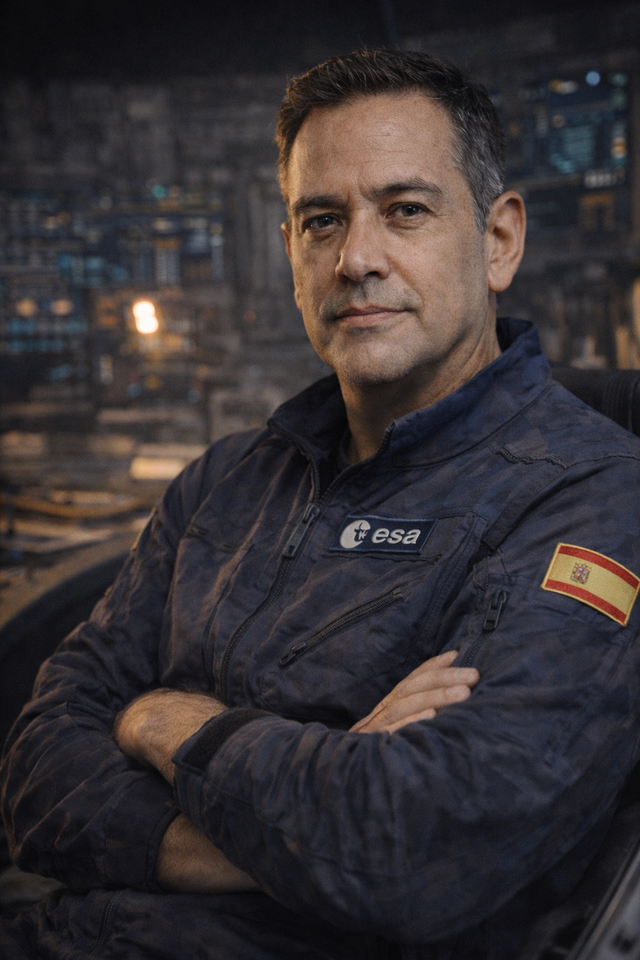
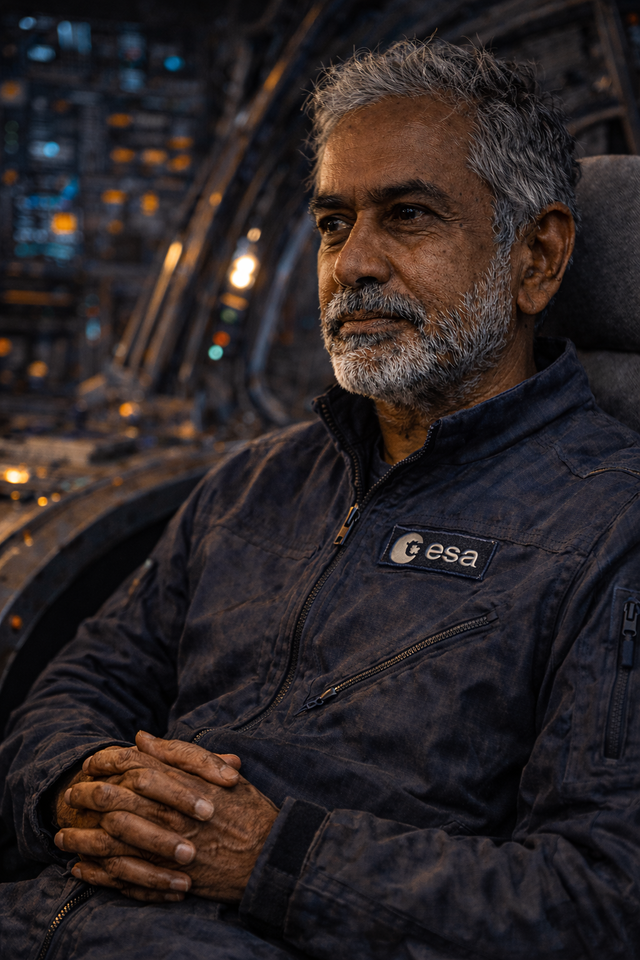
The coffee was cold. That was the first thing Anya noticed, not the data, not the faint chime of the processing alert she'd been waiting eleven months to hear, but the fact that her coffee had gone cold again, the powdered creamer forming a gray skin on the surface like pond ice in November. She'd been holding the mug for twenty minutes without drinking, the way her father used to hold his tea back in the cramped study in Lagos, staring at printouts until the liquid went tepid and the cup became just a warm thing to grip while his mind traveled somewhere impossibly far away.
She set the mug down on the console. The magnetic base clicked against the steel surface with a sound like a small, final punctuation mark.
"Concordia's processing is complete," said the voice of the station AI, a pleasant mid Atlantic accent that someone at ESA had thought would be soothing. It was not soothing. It was the voice of a hotel concierge delivering news of a flood. "First light composite imagery is available for review."
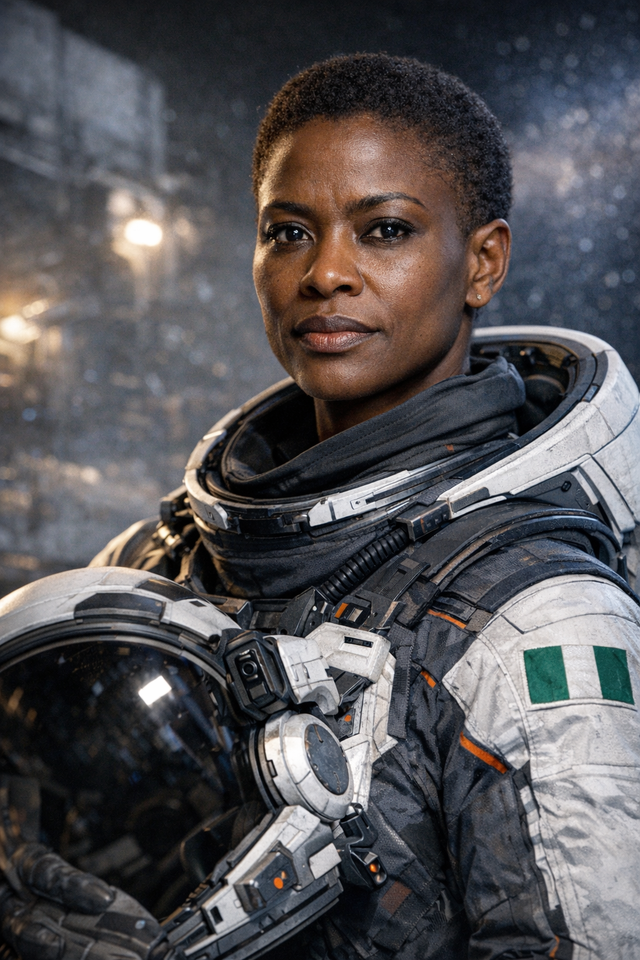
Anya Okafor, forty two, PhD from Cambridge, postdoc at Leiden, eight peer reviewed papers on large scale cosmic flows, currently the lead astrophysicist aboard the survey vessel Meridian and the woman who had spent the better part of a decade quietly, carefully, and with considerable political maneuvering ensuring this moment would happen, Anya Okafor wiped her palms on her trousers and pulled up the display.
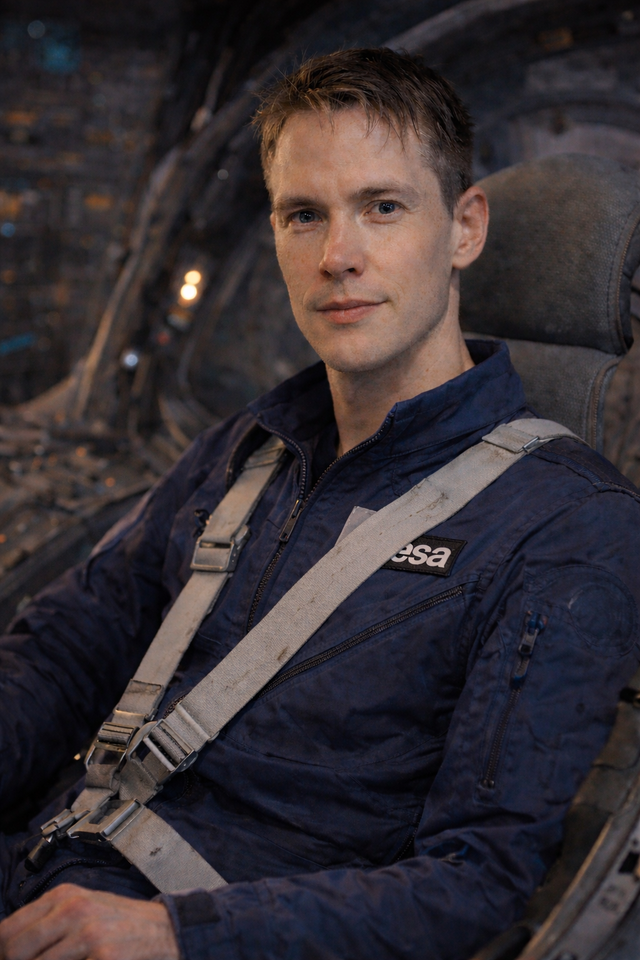
Eleven months. Eleven months of calibrations, mirror alignments, software patches transmitted from Darmstadt at the speed of light and arriving five seconds later, which doesn't sound like much until you're waiting for a fix to a thermal regulation bug while your billion euro telescope floats forty kilometers away in the permanent shadow of its own sunshield. The Meridian and Concordia shared an orbit at L2, the Sun Earth Lagrange point, one and a half million kilometers from home, but they did not share a hull. Concordia was an infrared telescope. Its sixty one hexagonal mirror segments, each 1.3 meters across, gold coated and nested together like cells in a honeycomb, operated at forty Kelvin. Forty Kelvin was minus two hundred and thirty three degrees Celsius, cold enough that the faintest warmth from a human body, from a life support system, from the vibration of a ventilation fan through a shared structure, would blind the instrument to the very thing it was built to see. So the Meridian stayed forty kilometers away, close enough to operate and maintain the telescope by remote uplink, far enough that twelve human bodies and their inconvenient warmth couldn't contaminate the data. The only physical link was the service pod in the hangar bay, a squat, windowless craft that Kai had flown out to Concordia twice during commissioning and then parked with the air of a man putting away a tool he hoped he wouldn't need again.
Eleven months since Concordia had unfurled its twenty two meter primary mirror like a golden flower blooming in the permanent shadow behind Earth, pointed away from the Sun and the Moon and everything that might pollute its vision with warmth or light or hope.
Pointed instead at the one place in the sky they couldn't see.
The Zone of Avoidance. She'd always hated the name. It sounded like a neighborhood you drove around after dark, not a fundamental obstruction in humanity's view of the cosmos. But that's what it was: the fat belt of the Milky Way's own galactic plane, choked with dust and gas and stars so dense and bright they blotted out everything behind them like a curtain drawn across twenty percent of the observable universe. You could see in every other direction. You could map galaxy clusters billions of light-years away, chart the cosmic web, trace the large scale structure of creation itself. But right through the middle of your own galaxy? Nothing. A smear. Static.
And behind that static, something was pulling.
She'd first heard about the Great Attractor when she was nine. Her father, Dr. Emeka Okafor, had been drinking palm wine on the veranda of their house in Victoria Island while the generator hummed and the Lagos night pressed in warm and loud with frogs and distant music. She'd come outside because she couldn't sleep, and he'd lifted her onto his lap and pointed at the sky (what you could see of it through the light pollution and humidity) and told her about the thing that was eating the universe.
"Not eating," he'd corrected himself, laughing at her expression. "Pulling. Like a drain in a bathtub. Everything around it (hundreds of thousands of galaxies, Anya, galaxies with hundreds of billions of stars), they are all sliding toward the same point. We can feel it. We can measure it. But we cannot see it."
"Why not?"
"Because our own galaxy is in the way." He'd swept his hand across the sky. "All this dust, all this light, it blocks our view. We are like someone trying to look through a frosted window. We know something is on the other side because we can feel the cold coming through. But we cannot see its face."
She'd asked him what he thought it was, and his hand had tightened on his glass, and he'd said something she didn't understand until years later: "I think it is something that wants to be found."
Her father had spent thirty one years studying the Great Attractor. He'd published his first paper in 1998, a careful analysis of peculiar galaxy velocities in the direction of Centaurus, and his last in 2031, a speculative piece on anomalous clustering patterns behind the Zone of Avoidance that had been rejected by Nature, accepted by a minor European journal, and politely ignored by everyone. Between those dates he had mapped redshifts, begged for radio telescope time, collaborated with teams in South Africa and Australia who were using hydrogen-line emissions to peer dimly through the galactic fog, and assembled, piece by painstaking piece, a picture that nobody wanted to look at.
The galaxy clusters behind the Zone of Avoidance, he argued, were not randomly distributed. They showed signs of geometric regularity, alignments, spacings, angular relationships that deviated from the stochastic filamentary web predicted by Lambda-CDM cosmology. Not by much. Not enough to be obvious. But enough, if you looked at his data the right way, to suggest that someone had been arranging furniture.
Nobody looked at his data the right way. His colleagues called it pareidolia. Pattern recognition gone haywire. The human brain seeing faces in clouds. Emeka Okafor, they whispered at conferences, had spent so long staring into the static that he'd started seeing messages in it.
He died in 2034, in his study in Lagos, surrounded by printouts and cold tea. Heart attack. Sixty eight years old. Anya had flown from Leiden for the funeral and spent three days sitting in his study, not crying, just reading his notes, understanding for the first time the full architecture of what he'd built. The geometric relationships. The angular harmonics. The way certain galaxy clusters, barely glimpsed through the Zone of Avoidance, seemed to form arcs and lines that repeated at consistent intervals, like...
She couldn't name the resemblance. A pattern in a carpet, rivets in a hull, nodes in a circuit. The comparison kept shifting because none of them were right and all of them were close.
She'd closed the notebooks and flown back to the Netherlands and told herself she wasn't going to be her father. She was going to do real science. Measurable, falsifiable, peer reviewed science. She was going to study the Great Attractor because it was a genuinely fascinating gravitational anomaly, a mass concentration of perhaps ten thousand Milky Ways' worth of matter, a supercluster called Laniakea, a thing that deserved study on its own merits without dragging in speculation about geometric patterns and cosmic architecture.
And then, three years later, she'd written the proposal for Concordia. Twenty two meters of segmented mirror, cryogenically cooled, parked at L2, pointed at the galactic plane. She'd framed it as pure cosmology: understanding the local universe's mass distribution, resolving the Great Attractor, mapping the hidden quarter of the sky. All true. All real science. And all of it a cover for the fact that she needed to know if her father had been right.
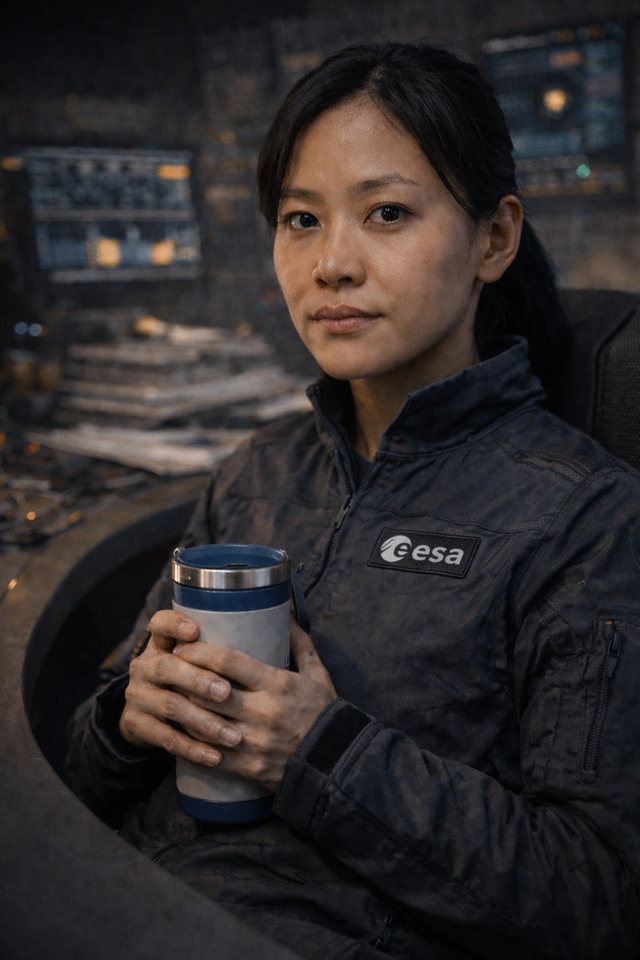
"You're doing the face," said Mei-Ling Zhao, sliding into the adjacent console chair with a thermos of something that smelled like jasmine and engine coolant. Mei-Ling was barely over five feet, perpetually cold despite the station maintaining a steady twenty one degrees Celsius, and wrapped in a blanket she'd brought from home that had cartoon penguins on it. She was also, in Anya's professional opinion, the best data scientist working in observational cosmology, which was why Anya had recruited her for this mission and why Anya was now mildly terrified that Mei-Ling was going to see her face and know exactly what the face meant.
"I don't have a face."
"You have a very specific face. It's the face you make when you're about to tell me something is statistically significant and I'm about to tell you it isn't. I've seen this face at four conferences and one very memorable department Christmas party. The face precedes disappointment."
"First light data just came through."
Mei-Ling set down her thermos. The casual evaporated. Whatever else she was, skeptic, realist, relentless debunker of premature conclusions, she was also a scientist, and first light data from a telescope that could see through the Zone of Avoidance was the kind of thing you set down your thermos for.
"Show me."
Anya pulled the composite image onto the main display. The screen flooded with light. So much of it, so suddenly, that her first thought was a calibration error, a saturated detector, something wrong. But nothing was wrong. Concordia's infrared eyes had looked through the galactic plane and found what was behind it, thousands of sources burning through the dust like embers through gauze, the hidden sky showing itself for the first time in...
Well. Ever. By human eyes, ever.
"Oh," Mei-Ling said. Not the reverent whisper Anya had imagined during eleven months of waiting. A flat, diagnostic syllable. The sound a mechanic makes when she opens the hood and sees the problem before the owner does.
"What?"
"Look at the PSF." Mei-Ling was already pulling up the point spread function diagnostic, a grid of reference stars across the field that should have appeared as clean, symmetric dots of light. They didn't. The stars in the upper left quadrant were smeared, each one trailing a faint coma tail that curved in the same direction, like iron filings near a magnet. "We've got coma in the outer field. Segments twenty two through thirty one."
Anya felt something drop inside her chest. She looked at the main image again, and now she could see it, the distortion she'd been too excited, too desperate, to notice on the first glance. The galaxy clusters behind the Zone of Avoidance were there, thousands of them, visible for the first time at this resolution, but many of them were elongated. Stretched along arcs that tracked with the direction of the coma tails. And there were structures. Sweeping curves of galaxy clusters arranged in great arcs across hundreds of millions of light-years. Arcs that looked...
That looked like her father's diagrams.
Her hands went cold. She gripped the edge of the console.
"The phasing is off," Mei-Ling said, pulling up the wavefront sensor readout. The display showed Concordia's sixty one mirror segments in their hexagonal grid, each one color coded by its deviation from the ideal wavefront. Most were green. Segments twenty two through thirty one, a wedge of the outer ring, glowed amber and red. "Eighty to a hundred and twenty nanometers of piston error on those ten segments. That's enough to produce exactly this kind of coma. The arcs in the image track the coma vector."
"All of them?"
"Most of them. Maybe all of them. I can't tell yet, because the real structure and the coma smear are superimposed on each other. If there are genuine arcs in the data, they're buried under the artifacts. We can't separate them until we clean up the phasing."
Anya stared at the image. The arcs. The curves. She'd seen these shapes before. Not in telescope data but in her father's notebooks, drawn in his cramped, precise handwriting. He'd predicted geometric regularity in the galaxy cluster distribution behind the Zone of Avoidance. He'd sketched arcs. And now, arcs were exactly what a misaligned mirror would paint across the sky, coma tails and astigmatic smearing that mimicked the very structures he'd spent his life trying to find.
The universe was either confirming her father's life work or playing the cruelest joke in the history of optics, and she could not tell which.
"We need to re-phase," Anya said. Her voice was steady. Her hands were not.
"Starting the actuator sequence now."
Mei-Ling began entering commands, and Anya sat very still, watching the image on the main display, the galaxy clusters glowing in false color behind the lifted veil of the galactic plane, the arcs sweeping through them like brushstrokes on wet canvas, beautiful, suspect, and possibly the most important thing anyone had ever seen, or possibly nothing at all.